
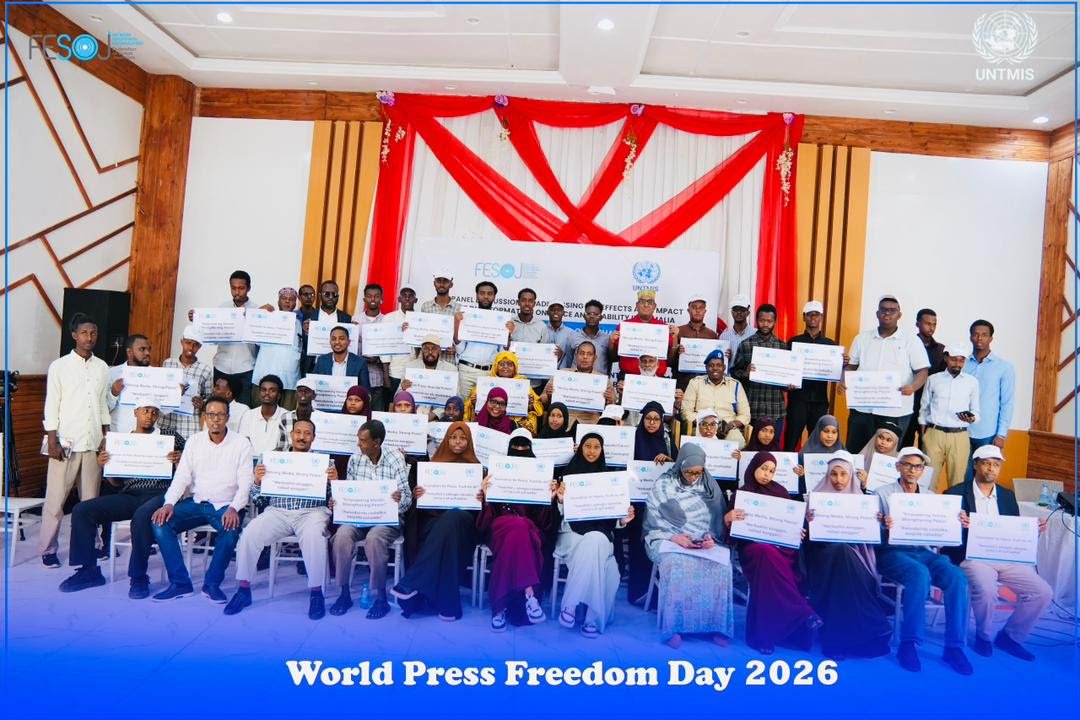
Mogadishu, Monday, May 4, 2026 — In partnership with the United Nations Transitional Assistance Mission in Somalia (UNTMIS), the Federation of Somali Journalists (FESOJ) organized a one-day event to mark World Press Freedom Day, in focus with discussion on the state of media freedom in Somalia and WPFD 2026 theme. The event took place at Beerta Nabadda (Peace Garden) in Mogadishu, Somalia.
This year’s World Press Freedom Day, observed annually on May 3, provided an opportunity to highlight the themes of the WPFD 2026, which is “Shaping a Future at Peace,” focusing on the role of journalism in promoting peace and dialogue. In Somalia’s context, a free press supports informed public debate, counters misinformation, and contributes to peacebuilding and social cohesion.
Opening the event, Farah Omar Nur, Secretary General of FESOJ, stressed the significance of World Press Freedom Day as an opportunity to recognize the essential role of journalists in improving peace and dialogue. “We are jointly discussing the WPFD 2026 theme, focusing on addressing the effects and impact of disinformation on peace and stability in Somalia.” He further explained
The event began with a comprehensive presentation session outlining the history of World Press Freedom Day, first recognized in 1993 by the United Nations. It was inspired by the Windhoek Declaration, adopted by African journalists in 1991.
The presentation underlined the day’s significance as a reminder to governments respect press freedom, the key recommendations by UNESCO for World Press Freedom Day 2026 including protect press freedom, ensure safety of journalists, fight disinformation, promote media and information literacy, address digital and A.I challenges, strengthen independent media and link press freedom to peace and development.
The panel discussion that followed was enhanced by a diverse group of speakers, including Major Abdifatah Adan Hassan, Spokesperson of the Somali Police Force; Abdi A. Mohamed (Baffo), Director of DHAXALREEB Center, Abdirahman Rooble, Senior/Veteran journalist, Duniya Mohamed Ali, Civil Society Representative and Mohamed Abdirisak , Lawyer, Hiil Law Firm. Jointly, the panelists session moderated by Mohamed Mohamud Adde , Senior Journalist provided a balanced analysis of addressing the effects and impact of disinformation on peace and stability in Somalia.
The discussion explored the significance of the World Press Freedom Day 2026 theme, highlighted the vital role of journalists in promoting peace and stability in Somalia. The panelists stressed the need to build the capacity of journalists to raise awareness within communities. The discussion also underlined the importance of respecting the Constitution to safeguard press freedom and prevent disinformation. Furthermore, the debate called for strengthening cooperation between security agencies and the media to enhance the overall social security.
In his closing remarks, Farah Omar Nur, FESOJ Secretary General reaffirmed that a free, independent, and responsible media is essential for peace and stability in Somalia. The insights shared today have highlighted both the progress made and the challenges that remain—particularly the growing threat of disinformation. He noted this event serve as a renewed commitment to strengthen journalists’ capacity, enhance cooperation among stakeholders, and promote responsible media practices that contribute to peace.
As part of the event, FESOJ distributed brochures that highlighted key messages about the importance of press freedom. The printed slogans, including “Voices of Truth Build Stronger Societies.” “Strong Media, Strong Peace.”, “Empowering Voices, Strengthening Peace.”, “Journalism for Peace, Truth for All.”, “Free Press, Peaceful Future.”, were prominently displayed throughout the venue.
The event was concluded with a collective display of solidarity at Beerta Nabadda, where participants walked together, displaying the printed messages as a powerful visual reminder of the media’s central role in promoting peace and dialogue. This gesture reinforced the critical need for promoting responsible media practices that contribute to peace.


